
From afterthought to cornerstone
The case for professionalised lived experience leadership in post-hospital stroke care

Author: Paul Quinn, stroke survivor, patient advocate and independent analyst
8th July 2026
Summary
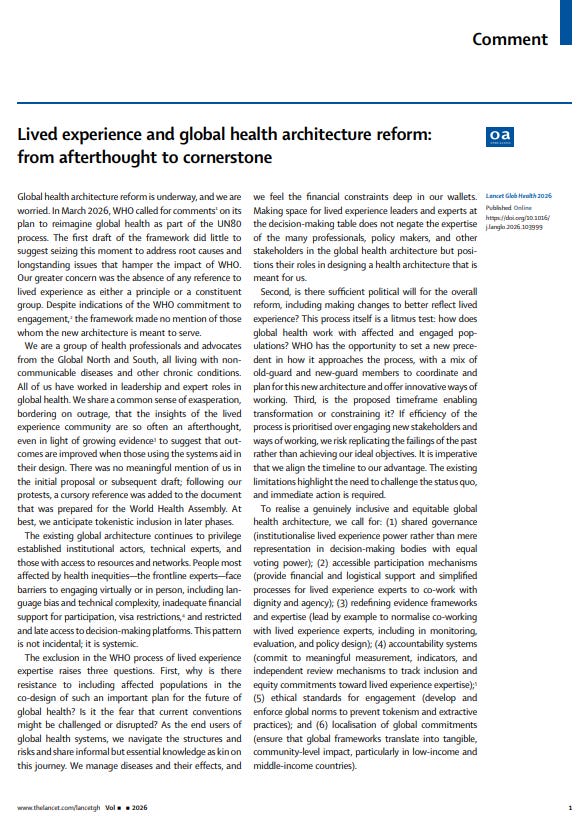
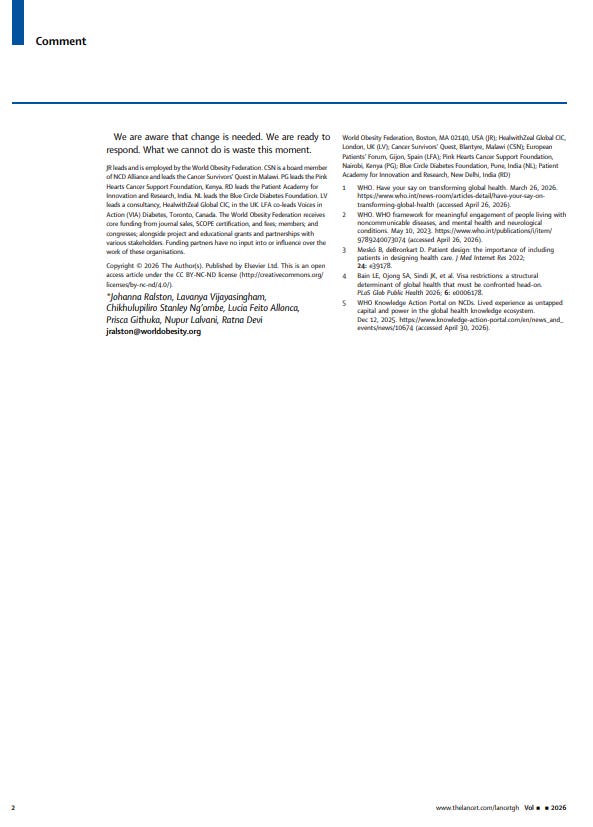
In 2026 a group of senior health professionals and advocates, all living with non-communicable diseases, published a Comment in The Lancet Global Health arguing that the reform of global health architecture, the WHO-led UN80 “reimagining” process, had once again treated the people health systems exist to serve as an afterthought.
Their response was not a plea for consultation. It was a set of six structural demands: shared governance with voting power, funded and accessible participation, redefined evidence frameworks, accountability systems, enforceable ethical standards, and localisation of global commitments into community-level impact.
This paper takes that framework and applies it to the area of English health commissioning where the gap between clinical achievement and lived reality is arguably widest: post-hospital stroke care.
Acute stroke care in England has been transformed over two decades.
What happens after discharge has not kept pace, and the economics prove it: of the £26 billion annual societal cost of stroke in the UK, only around £3.4 billion falls on the NHS. £15.8 billion, 61 per cent, is unpaid care carried by families after the hospital doors close. The post-hospital phase is simultaneously the most expensive part of the pathway and the part in which professional services are thinnest.
It is also the phase in which lived experience expertise is strongest.
Stroke survivors hold operational knowledge, of cognitive fatigue, invisible impairment, identity loss, family adjustment and isolation, that clinical teams cannot transmit in the time available to them, and that national policy already recognises: peer support is a named core element of the NHS Integrated Life After Stroke Support model.
The question for commissioners is therefore not whether lived experience belongs in the pathway. Policy has settled that. The question is whether it is engaged as unpaid, unstructured goodwill, the tokenism the Lancet authors warn against, or professionalised: recruited, trained, paid, supervised, measured and committed to over multiple years.
The core proposition
Lived experience should be commissioned as workforce, not gathered as feedback. We need approval for a professionalised lived experience programme in the post-hospital stroke pathway, governance seats with voting rights, paid peer support and lived experience practitioner roles embedded in the community stroke service and six-month reviews, accredited training, and a minimum three-to-five-year funding commitment with defined accountability metrics.
The economic case rests on three verified facts.
First, scale and trajectory: UK societal stroke costs are projected to rise from £26 billion (2015) to £43 billion in 2025 and £75 billion by 2035 as the survivor population more than doubles, from 1.4 per cent to 2.9 per cent of GDP.
Second, concentration: a first-year stroke costs society an average £45,409, and each subsequent year £24,778 per survivor; the dominant cost lines (unpaid care, social care escalation, recurrence) sit precisely where peer and lived experience support operates.
Third, the activation mechanism: NHS England’s own supported self-management guidance records that people who lack the confidence to manage their health are up to ten times higher users of services, and identifies peer support as the evidenced lever on that confidence.
Against per-stroke costs of this magnitude, a lived experience service needs to avert only a handful of first-year-equivalent cost events annually to cover its own cost, a threshold set out transparently below.
What the Lancet Global Health comment says, and why it is different
The Comment “Lived experience and global health architecture reform: from afterthought to cornerstone” (Ralston, Vijayasingham, Ng’ombe, Feito Allonca, Githuka, Lalvani, Devi; Lancet Global Health, 2026), responds to WHO’s March 2026 call for comments on its plan to reimagine global health under the UN80 process.
The authors’ complaint is precise: the first draft framework contained no reference to lived experience as either a principle or a constituent group; a cursory reference was added only after protest; and the authors anticipate, at best, tokenistic inclusion in later phases.
Their diagnosis is that the exclusion is not incidental but systemic, the architecture privileges established institutional actors, technical experts and those with access to resources, while the people most affected face language bias, technical complexity, inadequate financial support, visa restrictions and late access to decision-making platforms.
Three features distinguish this document from the familiar genre of engagement rhetoric, and they are the features a commissioning board should register.
Authority. Its authors are dual-credentialed. They are not service users invited to comment; they are health professionals and organisational leaders from the Global North and South who also live with non-communicable and chronic conditions. The paper is itself a demonstration that lived experience and professional expertise are not opposing categories, the exact premise of a professionalisation agenda.
Structure over sentiment. The Comment explicitly rejects representation without power. Its first call is for “shared governance”, institutionalised lived experience power with equal voting rights in decision-making bodies, not advisory seats. Every subsequent call (funded participation, redefined evidence frameworks, accountability metrics, ethical standards, localisation) is structural rather than attitudinal.
Complementarity, not displacement. The authors frame inclusion carefully: making space for lived experience leaders “does not negate the expertise” of professionals and policy makers, but positions those roles in service of an architecture designed for the people who use it. This is the framing that disarms clinical resistance, and it should be adopted verbatim in local commissioning conversations.
The six calls, the operating framework for this paper
(1) Shared governance: institutionalise lived experience power, with equal voting rights.
(2) Accessible participation mechanisms: financial and logistical support, simplified processes, dignity and agency.
(3) Redefined evidence frameworks and expertise: normalise co-working with lived experience experts in monitoring, evaluation and policy design.
(4) Accountability systems: meaningful measurement, indicators and independent review of inclusion commitments.
(5) Ethical standards of engagement: enforceable norms preventing tokenism and extractive practice.
(6) Localisation: global frameworks translated into tangible community-level impact.
The authors close with a warning that carries directly into local commissioning: if efficiency of process is prioritised over engaging new stakeholders and ways of working, the reform will replicate the failings of the past. A commissioning cycle that consults survivors after the service specification is drafted is the local equivalent of the WHO drafting failure the Comment describes.
What this means for lived experience advocacy
For advocates, the Comment does three jobs that no amount of local testimony can do alone.
First, it relocates the argument. Lived experience inclusion is no longer a courtesy extended by services to patients; it is a design principle of health architecture asserted in one of the world’s leading peer-reviewed global health journals by authors who lead international health organisations. When a local commissioning body is asked to fund lived experience roles, the request now sits inside a documented international reform agenda, the same direction of travel as WHO’s 2023 Framework for Meaningful Engagement of people living with NCDs, which the Comment cites as an unfulfilled commitment. Advocates should use it as an anchor citation: the ask is alignment with published global standards, not special pleading.
Second, it supplies a vocabulary of professionalisation. Each of the six calls converts directly into a commissionable specification:
governance seats become constitutional amendments to board terms of reference;
“accessible participation” becomes a remuneration and reasonable-adjustment policy;
“redefined evidence frameworks” becomes paid lived experience roles in service evaluation and co-design;
“accountability” becomes contract KPIs;
“ethical standards” becomes an anti-tokenism charter with training, supervision and progression routes;
“localisation” becomes community-delivered peer support.
The Comment, in other words, is a specification template disguised as an opinion piece.
Third, it names the failure mode. “Tokenistic inclusion in later phases” is exactly what most NHS engagement currently delivers: the survivor invited to tell their story at the annual general meeting, unpaid, after decisions are made.
The evidence the Comment cites (Meskó and deBronkart, 2022) is that outcomes improve when the people who use systems help design them, participation is an effectiveness intervention, not a decoration.
Advocacy that accepts unpaid, unstructured involvement is now arguing below the published standard.
Advocacy position statement
Lived experience is a form of expertise with an evidence base, an international policy mandate and a professional development pathway. It should be procured, contracted and quality-assured on the same basis as any other scarce expertise in the pathway. Anything less is the tokenism the Lancet authors describe — and tokenism is now a documented, citable failure mode, not merely a disappointment.
The stroke pathway: where the six calls land
Stroke is the strongest single test case for the Comment’s agenda in English commissioning, for two reasons.
The clinical reason: stroke is the leading cause of adult disability in the UK, with more than 100,000 new strokes and well over a million survivors, more than half living with a resulting disability.
The structural reason: national policy has already built the scaffolding into which lived experience roles fit.
The NHS Long Term Plan made stroke a national priority and committed to raising six-month post-stroke reviews from 29 per cent to 90 per cent of patients.
The National Stroke Service Model and the Integrated Community Stroke Service (ICSS) model require seven-day community rehabilitation, six-month reviews and longer-term support delivered in collaboration with the voluntary sector.
Most significantly, the national guidance for an Integrated Life After Stroke Support (ILASS) model names peer support as a core element of life after stroke support, alongside the holistic six-month review, emotional support, communication support, return-to-work support and carer support.
Commissioning professionalised lived experience roles in stroke is therefore not an innovation requiring a leap of faith. It is the completion of a published national service model that most systems have only partially implemented. The table below maps the Comment’s six calls onto the existing stroke commissioning architecture.
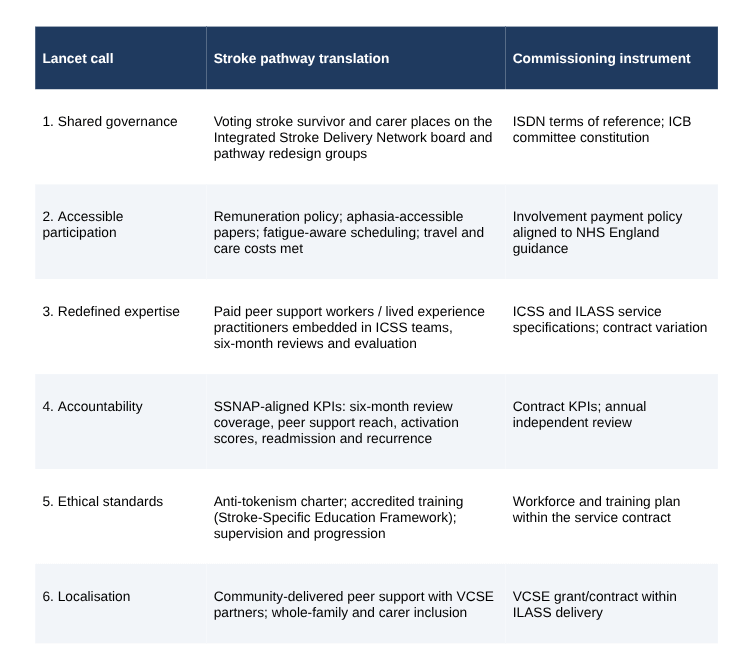
Note the asymmetry of effort. Calls 1, 2, 4 and 5 are close to cost-neutral: they are governance and policy changes. The material investment sits in call 3, the paid roles, and call 6, community delivery.
The survivor’s evidence: integrating the lived experience message
The Lancet Comment supplies the architecture; the content of what lived experience contributes in stroke is best demonstrated from the survivor literature itself.
I write from direct experience, two strokes in 2023, and have since built a body of work on lived experience in stroke recovery; including “Patient Advocacy and Peer Support for Stroke Survivors” and “What Stroke Survivors Want You to Know”; the Talking about Strokes podcast, which brings survivors, families, carers and clinicians into structured peer-to-peer conversation; and presentation of lived experience work at the European Life After Stroke Forum and the European Parliament.
Three themes from that body of work, each echoed across the wider survivor literature, translate directly into commissionable value.
The knowledge clinicians cannot transmit
The recurring finding of the written series is that the most disabling impacts of stroke in the community phase are cognitive and invisible: fluctuating cognition through the day, memory retrieval failures that are connectivity problems rather than lost memories, fatigue that punishes overexertion with setbacks, heightened sensitivity and temper.
These impacts “are not often spoken about, there’s not the time or resources in the immediate period you are in hospital, let alone when you go home.” That is not a criticism of clinicians; it is a capacity statement. The knowledge of how to live with these impacts, pacing, cueing, repetition strategies, when to rest, resides overwhelmingly in the survivor community, and a pathway that does not commission a channel for it simply does not deliver it.
The family is a second patient
The series argues that those closest to the survivor are “in shock too”, adjusting to a changed reality on second-hand information from an unreliable source, the survivor themselves in the early months.
Lived experience support is the only credible translator between the survivor’s interior experience and the family’s need to understand it. This maps directly onto the economics: unpaid family care is 61 per cent of the total societal cost of stroke, and carer breakdown is the single most common trigger for care-package escalation and residential placement. Support that keeps informal care sustainable acts on the largest cost line in the entire pathway. The ILASS model’s requirement for whole-family carer support acknowledges this; peer-delivered support operationalises it.
The dual dividend: purpose as an outcome
The advocacy writing is explicit that involvement in peer support and patient advocacy “can reverse that impact, bring new purpose and perhaps most importantly add huge value through the lived experience of being a stroke survivor.”
This is the distinctive feature of lived experience workforce models, replicated in the mental health peer workforce evidence: the intervention benefits the deliverer as well as the recipient. A commissioned lived experience programme creates supported routes back to contribution, and in some cases employment, for survivors, a quarter of whom are of working age and 37 per cent of whom otherwise leave the workforce. No other workforce investment available to a commissioner pays out on both sides of the transaction.
The integrated message
Post-hospital stroke care has a structural gap that clinical services cannot close within their capacity: the transmission of survival knowledge, the translation to families, and the restoration of purpose. The survivor community is an existing, willing and highly motivated workforce whose expertise targets precisely the highest-cost, least-served segment of the pathway. The Lancet Comment provides the mandate to engage it professionally; national stroke policy provides the service model; the economics provide the return.
The economic evidence
Scale, trajectory and concentration of cost
The authoritative UK cost base is the Queen Mary University of London / LSE work published in Age and Ageing (2020) and adopted by the Stroke Association. Its findings, at constant 2015 prices, are set out below.
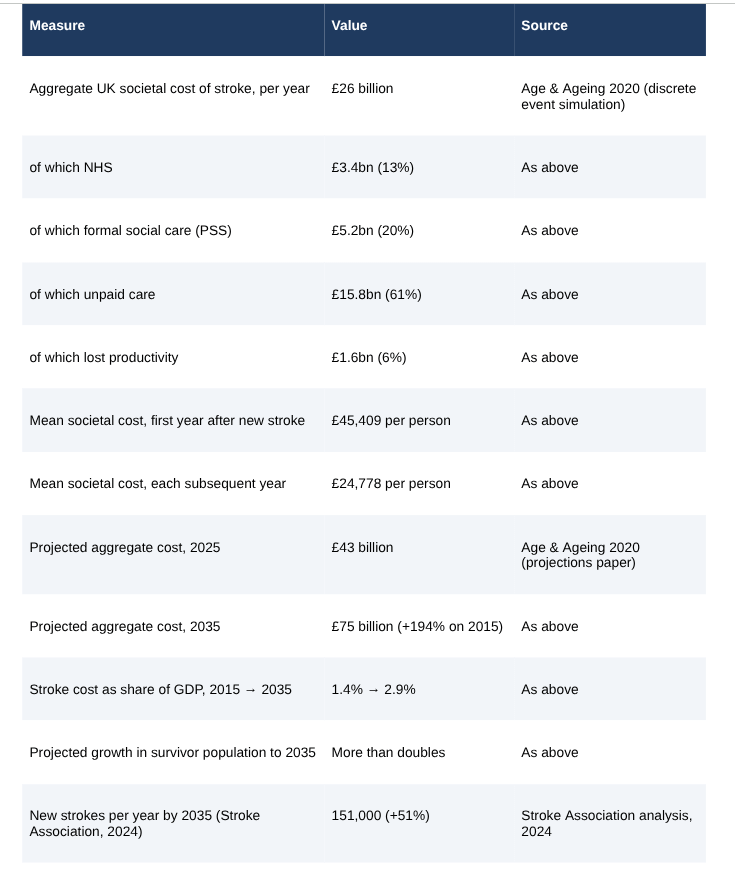
Two structural facts in this table should drive commissioning strategy.
First, the NHS line is the smallest major component: a commissioner who evaluates post-hospital investment only against NHS expenditure is measuring 13 per cent of the problem.
Second, the cost of stroke is a prevalence problem, not an incidence problem, prevalent survivors, at £24,778 per year each, dominate the aggregate because there are roughly 950,000 of them against roughly 118,000 new strokes. The post-hospital, long-term phase is where the money is, and it is the phase lived experience support serves.
The mechanism: activation, self-management and peer support
NHS England’s supported self-management guidance states the mechanism plainly: people who lack the knowledge, skills and confidence to manage their health and wellbeing are up to ten times higher users of services, and peer support, explicitly defined as using the skills and expertise of people with lived experience, is an evidenced route to building that confidence, improving quality of life and reducing pressure on the system. This is not advocacy literature; it is the commissioner’s own national guidance.
The direct effectiveness and cost evidence for peer support is strongest in mental health, where the professionalised peer workforce is most mature, and it points consistently in one direction. The NIHR-supported umbrella evidence found peer work promotes hope, empowerment, patient activation and self-efficacy and reduces hospitalisations; NIHR’s evidence review of peer support workers reported that the studies addressing cost found peer support low cost and potentially cost-saving; ImROC’s implementation work records that adding peer workers to acute pathways shortened admissions and reduced readmission rates, generating significant savings; and the international Peers for Progress evidence review concluded peer support is generally cost-effective and often cost-saving across conditions and health systems.
In stroke specifically, the trial-grade health-economic literature is thinner, but the mechanism (activation, secondary prevention adherence, carer sustainability, reduced isolation and depression) is identical, the national ILASS model already mandates peer support as a pathway component, and delivery costs are anchored by real services: the ILASS guidance cites a Lincolnshire service running on 4.83 whole-time-equivalent stroke coordinators handling 742 referrals per year, roughly 154 people supported per WTE.
Illustrative break-even for a commissioned service
The following is presented transparently as an illustration, not a forecast.
Assume a commissioning footprint of one million people, implying very roughly 1,700 new strokes per year on national incidence. Assume a professionalised lived experience service of six WTE posts, four peer support workers / lived experience practitioners at NHS Agenda for Change band 3–4 equivalent (the banding used to cost peer support workers in published NHS economic evaluations), one coordinator and one governance/involvement lead, plus training, supervision, involvement payments and on-costs, at a fully loaded annual cost of approximately £300,000.
Break-even test
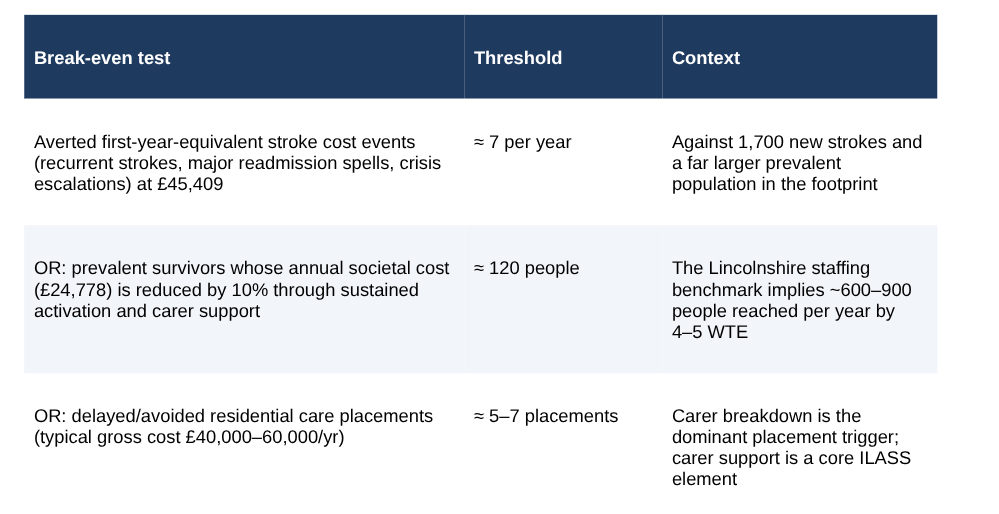
The tests are deliberately conservative and alternative, not cumulative: any one of them, achieved alone, covers the programme cost, and the reach benchmarks suggest the service would engage several hundred survivors and carers per year. A programme that reached 600 people and shifted outcomes for even a fifth of them would clear the second test three times over. The asymmetry between a £300,000 programme cost and a £26 billion national cost base, of which the footprint’s pro-rata share is of the order of £380 million per year, is the essential economic fact.
Commissioners are not being asked to bet that lived experience support transforms the cost of stroke; they are being asked to accept that it is implausible it fails to move outcomes by the fraction of one per cent required to pay for itself, when the national guidance already asserts the mechanism.
Recommendations
Below I list six resolutions, which mirror the Lancet Comment’s six calls and complete the ILASS/ICSS model locally.
Governance. Amend the terms of reference of the Integrated Stroke Delivery Network board and pathway redesign groups to create a minimum of two remunerated stroke survivor/carer places with full voting rights, recruited openly.
Participation. Adopt an involvement payment and reasonable-adjustment policy covering remuneration, aphasia-accessible materials, fatigue-aware scheduling, and travel and care costs, so that participation does not depend on private means.
Workforce. Vary the ICSS and life-after-stroke contracts to commission paid lived experience practitioner and peer support roles, embedded in community stroke teams and the six-month review process, at an initial establishment of the order set out above.
Accountability. Set contract KPIs: six-month review coverage toward the 90% Long Term Plan ambition; peer support reach and uptake; patient activation measures; readmission, recurrence and care-package escalation rates; and commission an annual independent review of inclusion commitments.
Ethics and standards. Adopt an anti-tokenism charter; require training and supervision aligned to the Stroke-Specific Education Framework; and establish progression routes from volunteer to paid practitioner roles.
Localisation. Deliver community-facing elements through VCSE partnership on multi-year terms, with explicit whole-family and carer inclusion.
The commitment that matters most
Approve funding on a minimum three-to-five-year horizon. Lived experience workforces are destroyed by annual funding cycles: recruitment, training, trust-building with survivors and integration with clinical teams consume the first eighteen months.
A one-year pilot is a decision to fail slowly, and is itself a form of the tokenism this paper argues against. The Lancet authors’ closing line applies to this board as much as to WHO: what we cannot do is waste this moment.
Caveats and data limitations
The Lancet Global Health article is a Comment, a peer-reviewed advocacy and analysis piece by named authors with declared organisational interests, not primary research. Its authority is positional and argumentative; the empirical claims in this paper rest on the separately cited cost and effectiveness literature.
The £26 billion cost base and the £43bn/£75bn projections are at constant 2015 prices and are model outputs (discrete event simulation and cell-based projection respectively), sensitive to assumptions on incidence, prevalence and real care-cost growth. The projections paper itself reports scenario ranges from +141% to +257% growth to 2035.
The strongest trial-grade economic evidence for professionalised peer support comes from mental health services, not stroke. Stroke-specific peer support evidence is largely observational and qualitative; the economic argument is explicitly an illustration built on verified unit costs and published staffing benchmarks, not a stroke-specific trial result. The board should commission its programme with evaluation built in, partly to close this gap.
The ten-times utilisation figure is NHS England’s published statement on low patient activation generally, not a stroke-specific estimate.
Break-even thresholds use societal costs, which include unpaid care and productivity. Cash-releasing savings to the NHS and local authority will be a subset; the case for investment is a whole-system and societal one, consistent with ICB statutory duties.
Declared interest: I am a stroke survivor and the writer of the Substack material cited in this article. That material is presented as testimony and synthesis of survivor experience, consistent with the paper’s argument that such testimony constitutes expertise; it is not presented as controlled research.
Principal sources
Ralston J, Vijayasingham L, Ng’ombe CS, Feito Allonca L, Githuka P, Lalvani N, Devi R. Lived experience and global health architecture reform: from afterthought to cornerstone. Lancet Global Health, 2026.
Patel A et al. Estimated societal costs of stroke in the UK based on a discrete event simulation. Age and Ageing, 2020; and: The future incidence, prevalence and costs of stroke in the UK. Age and Ageing, 2020. Published with the Stroke Association as Current, future and avoidable costs of stroke in the UK.
Stroke Association. Analysis and press releases on stroke costs and projections, 2017 and 2024.
NHS England. National Stroke Service Model (2021); National service model for an Integrated Community Stroke Service (2022); National guidance for an Integrated Life After Stroke Support model (2023); Supported self-management: peer support guide; NHS Long Term Plan (2019) stroke commitments.
NIHR Evidence. Can peer support workers benefit mental health services? (2024); NIHR Mental Health Policy Research Unit umbrella review of peer support (BMC Medicine/related, 2024).
ImROC. Peer Support Workers: Theory and Practice (citing Trachtenberg et al. on admission length and readmission savings).
Peers for Progress. Global Evidence for Peer Support: Humanizing Health Care.
WHO. Framework for meaningful engagement of people living with noncommunicable diseases, and mental health and neurological conditions, 2023.
Quinn P. Patient Advocacy and Peer Support for Stroke Survivors; What Stroke Survivors Want You to Know; My Stroke Journey series. theesk.substack.com, 2025.
# **1/2**
The business case is sound, and it's rational.
But people aren't. Organisations are worse.
Paul's numbers are correct, but they won't move a system alone
Resistance is structural, not financial.
EG The Stroke Association has the reach to lead this yet it resists outreach. Illustrating wider lack of interest; no vision from its existing vested interests. That's one symptom.
Another, at global scale.
The Lancet piece calls for equality. In any market, the customer doesn't plead for parity, they're the reason the business exists.
Sad that highly credentialed authors, several living with the conditions they write about, still frame a request as equality rather than primacy.
Clear evidence of how deep and invisible distortions run, even among those closest to it.
Both symptoms trace to the same root. Clinical and research expertise are treated as the two halves of the status quo. Lived expertise even if acknowledged is largely dismissed I started article states explicitly.
The community is why clinical and research work has value in the first place, and it alone receives the consequences of both. Its voice within those two domains ought maybe to outweighs them?
Continued...
## 2/2
Continued
Clinical and research combined are worth perhaps ⅔ the shared picture. The other ⅓, life-with-it, the community owns outright. That's 50% in total.
This distortion is real, and it is largely invisible. Governance is so often weaponised to protect the status quo because the people who hold the vision of what comes next, the community, are the very people the current architecture doesn't yet recognise as holding it. The imagination for a better future already exists. It just isn't sitting where the power is.
Low and middle income systems face the same governance challenges without the entrenched capacity to weaponise them in this way. That may make them the better place to prove what's possible first, then export it back to systems too invested in their own inertia to move otherwise.
An architecture that moves in this direction already exists: https://stroke.logicalmodel.net/flarum/public/d/567
A working example, already running: https://bit.ly/StrokeCommunity
It isn't a finished model. It's imaginable today, partly built, and designed to make invisible constraints visible so they can be removed. It evolves with more people and more time.
Read it. Argue with it. Help build it.